Key Features of Sky-Frame’s New Sliding Door Automation
A Guide to Sky-Frame’s New Power-Drive 200
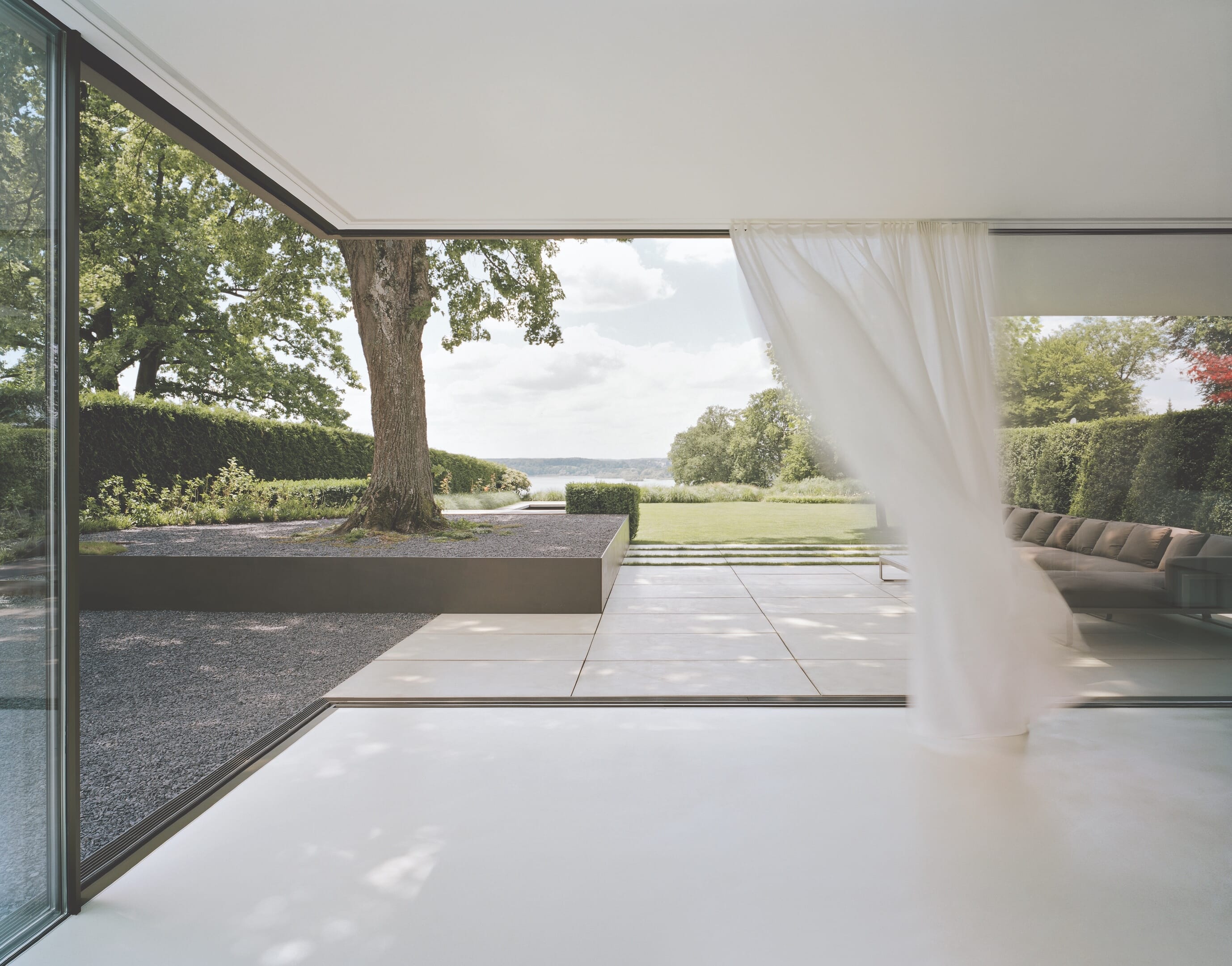
Imagine eight giant panels of floor to ceiling glass concertinaing open, silently revealing your outdoor space, at the touch of a button. The moment of drama when the two sides of an exposed corner window come together in perfect unison. Or an indoor swimming pool that magically becomes open air just by touching the screen of your smartphone. Automation doesn’t just make life more convenient, it makes it more spectacular.
It’s not surprising then, that automation is one of the most common questions asked about Sky-Frame sliding doors. And with Sky-Frame’s new Power-Drive 200 as standard from September 2026, the possibilities are even greater than before.
Read on to discover how automation integrates with the wider smart home environment and the benefits and features of Sky-Frame’s latest sliding door automation update.
The next-generation drive system: Sky-Frame Power-Drive 200
The market for large-format glazing is constantly evolving. Sliding elements are getting larger and heavier, and the performance demands placed on drive systems are increasing with them. The Power-Drive 200 (PD-200) has been developed by Sky-Frame to meet these requirements – purpose-built for the Sky-Frame system and introduced as the new standard from September 2026.
Key features of the PD-200:
- Silent operation of up to eight sliding elements from a single button press – via a wall-mounted switch, the Touch 2.0 control handle, or a smart home system
- Each panel is driven independently, ensuring controlled, sequenced movement – elements cannot slam into one another, giving consistently smooth and quiet operation
- Concealed within the upper frame profile, with no impact on the architecture or sightlines of the installation
- Capable of moving sashes weighing up to 1,000kg and accommodating opening widths of up to nine metres
- Suitable for corner configurations, with the control system managing the opening and closing sequence across both runs of glazing
- Programmable vent position and passage opening, allowing partially open positions to be set and recalled
- Manual operation in power failure – sliding elements can be opened and closed by hand in the event of a power outage, though the gear ratio means this requires more effort than normal operation
- Designed for a 30-year service life, with motor and control unit tested accordingly
Where configurations include more than three sashes in a row, solar heating in the glazing cavities must be taken into account during the planning phase. Appropriate measures – pocket or station doors, and a considered sun protection strategy – should be incorporated into the design from the outset.
Modes of operation
The PD-200 supports two operating modes, giving flexibility over how large or complex configurations open and close.
In retraction mode, all sliding elements move in the same direction, gathering to one side of the opening. In follow-me mode, elements move in sequence – one following the next – which is particularly effective for telescopic corner openings and configurations where elements stack on both sides.
Modes of control
The PD-200 can be operated in two ways, depending on the level of supervision maintained during operation.
- Dead man operation requires the user to hold a button or control continuously while the door moves. The panel stops the moment the control is released. This mode assumes the operator has a direct line of sight to the moving panel at all times and is the default for most residential installations.
- Touch mode allows a single press to open or close a door fully, with no need to remain present. That press can come from a wall keypad, the Sky-Frame Touch 2.0 control handle integrated into the locking mechanism, or a smartphone – making it possible to open a full-height glazed wall from the other side of the house, or to trigger the doors as part of an automated morning or evening routine.
Safety note: Because touch mode operates without constant supervision, Sky-Frame doors include collision detection, which stops the panel if resistance is encountered, but this does not eliminate risk entirely. Clients wishing to use touch mode are required to sign a liability disclaimer, acknowledging responsibility for ensuring the area is clear before activation. Safety regulations for touch mode also differ between residential and commercial or public-use buildings – a distinction that should be addressed during the design phase.
Integration with smart home systems
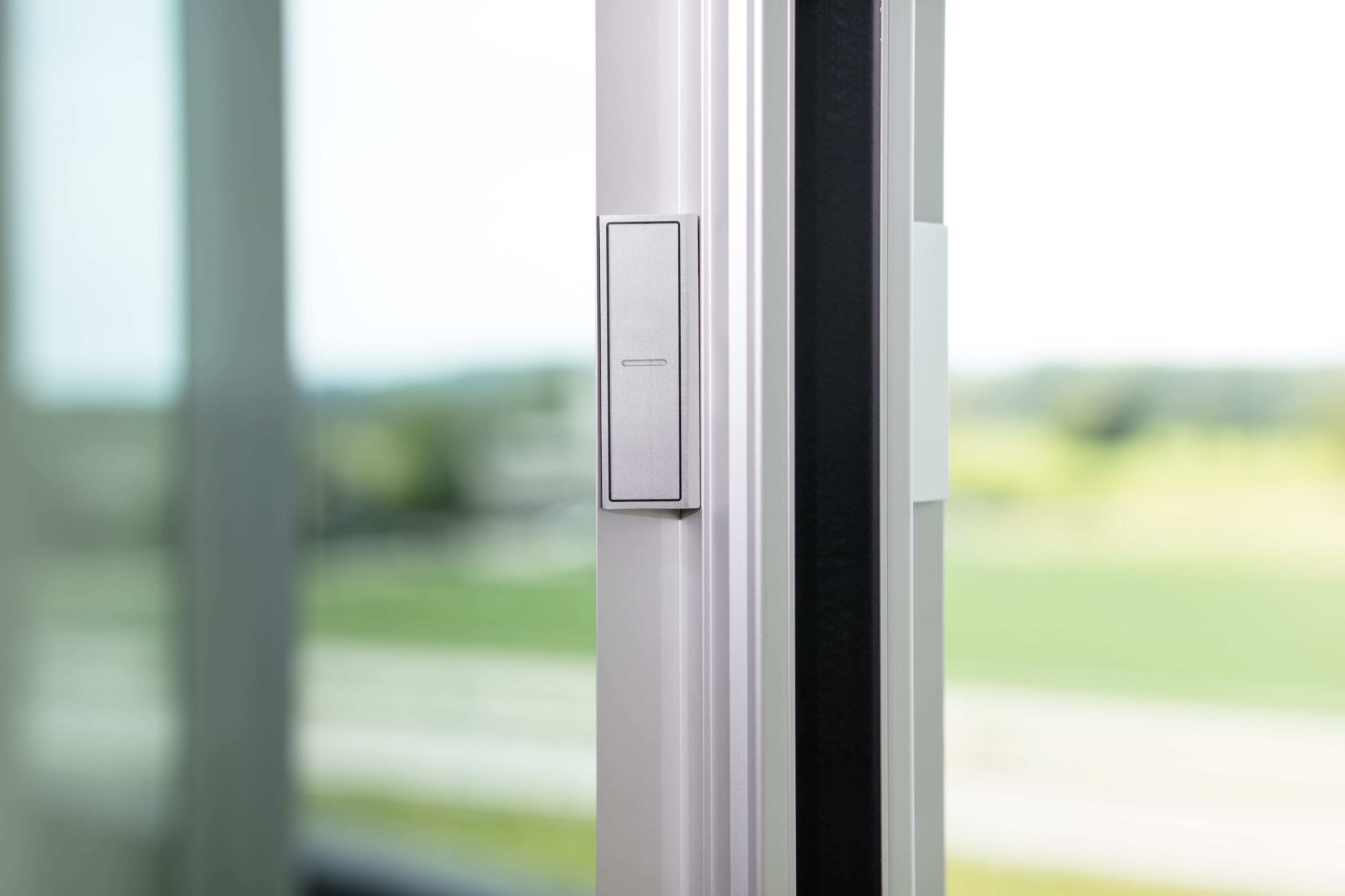
Sky-Frame’s Touch 2.0 control button, updated alongside the PD-200, offers greater wireless range and longer battery life than its predecessor – and sits cleanly within the locking handle without any visible external hardware.
Beyond button operation, Sky-Frame automation integrates into wider building management and smart home systems through position monitoring. This allows the status of each door – open, closed or locked – to be fed into a home automation platform in real time.
The most directly useful integration for residential projects is with air management. When connected to an MVHR (mechanical ventilation with heat recovery) or air conditioning system, the building management system can automatically adjust ventilation settings based on whether the doors are open. A large Sky-Frame opening represents a significant change in the thermal envelope of a building; enabling the system to respond automatically improves comfort and avoids energy waste.
Depending on the home automation platform specified, Sky-Frame position monitoring can also integrate with:
- Security and access control systems
- Lighting scenes and mood control
- Multi-room audio systems
- Smartphone apps for remote monitoring and control
For projects using Rako, KNX, Control4, Crestron or similar systems, the specific integration requirements – and the cabling and controller positions they demand – need to be resolved during the build phase, not after.
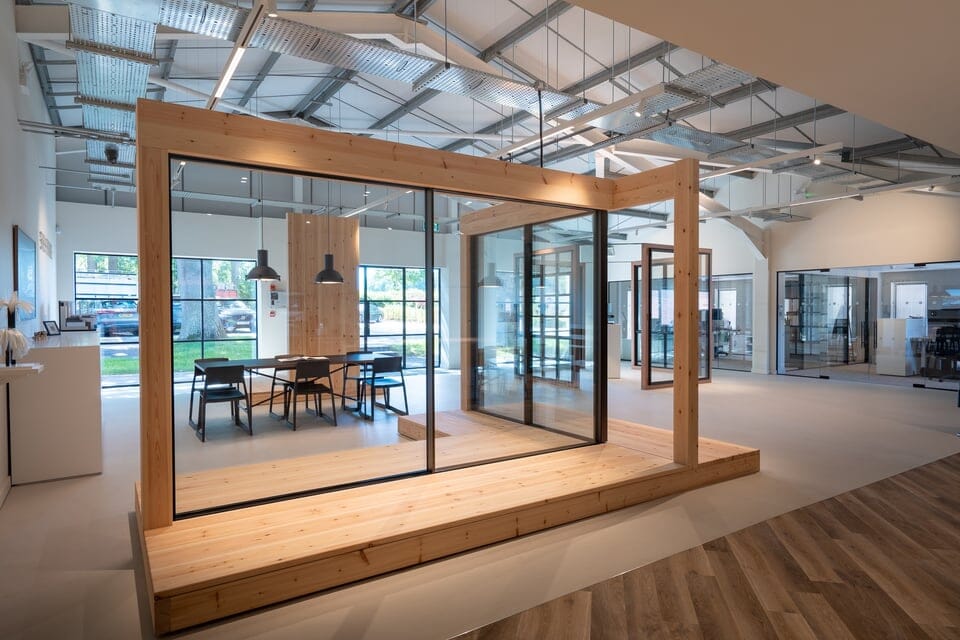
UltraView’s own Sky-Frame showroom in the Cotswolds uses Rako smart controls throughout, integrated with both the Sky-Frame automated doors and the XAL lighting scheme – a working demonstration of what a fully resolved system looks and feels like in practice.
A note on smart glass
Switchable glass – sometimes called LCD or electrochromic glass – is occasionally proposed as a complement to automated glazing, offering privacy at the touch of a button. It is suitable for specific applications – a bathroom partition, for example – but it is not routinely recommended for the principal glazing elements that have been specified for the optical clarity that Sky-Frame offers.
What automation means for specification
If automation is part of the brief, the housing needs to be detailed at the design phase of the project. Motor housings for the PD-200 must be integrated into the head detail of the frame during construction, with a minimum of 80mm of space required above the soffit profile. Retrofitting is possible but significantly more complex than building it in from the outset – and in some cases, existing structural conditions make it impractical.
If automation is a possibility – even a distant one – it is wise to plan it in early. It adds very little to the cost of the build and preserves full flexibility later. You can read more about glazing automation in our blog, A Guide to Automated Glass Doors.
Specifying Sky-Frame automation with UltraView
We welcome architects and their clients to experience working automated Sky-Frame configurations in our new Cotswolds showroom – the UK’s largest dedicated Sky-Frame installation. Both operating modes can be trialled directly before committing to a specification, and the team is available to work through automation requirements with you during the design phase, ensuring that whatever is detailed can be delivered on site without compromise.
Want to find out more about the possibilities of Sky-Frame automation for your next project?
FAQs: Sky-Frame automation
Can Sky-Frame sliding doors be opened and closed with a smartphone?
Yes. When integrated with a smart home system such as Rako, KNX, Control4 or Crestron, Sky-Frame doors can be triggered via a smartphone app, a dedicated remote or a wall keypad. A single tap is enough to open or close the door fully – making it straightforward to control large glazed openings as part of a wider smart home routine.
What is the Sky-Frame Power-Drive 200?
The Power-Drive 200 (PD-200) is Sky-Frame’s latest proprietary automation unit, available as standard from September 2026. Purpose-built for Sky-Frame, it replaces earlier systems that used third-party motor components, delivering greater performance, improved reliability and full system compatibility. It is capable of moving sashes up to 1,000kg and accommodating opening widths of up to nine metres, and has been tested to a 30-year service life.
What operating modes does the PD-200 support? Two modes: retraction mode, in which all panels move in the same direction and gather to one side; and follow-me mode, in which panels move in sequence, one following the next. Follow-me mode is particularly effective for corner configurations and systems where elements stack on both sides of the opening.
Can corner openings be operated from one side only?
Yes. Corner configurations can be set to open from one side only, including via the Touch 2.0 control handle. This requires a customised adjustment and should be specified at the design stage.
What happens if there is a power failure?
Sky-Frame panels can be opened and closed manually in the event of a power outage. The gear ratio of the drive mechanism means manual operation requires more effort than normal, and movement should be slow and controlled. For installations in locations with a higher risk of power interruption, an uninterruptible power supply (UPS) is recommended.
Can automation be added to an existing Sky-Frame installation?
It is possible but significantly more complex than specifying it from the outset. Motor housings must be integrated into the frame head during construction, requiring a minimum of 80mm above the soffit profile. Retrofitting is sometimes achievable, but structural constraints in existing buildings can make it impractical. Where automation is a future possibility, detailing the housing during the original build is strongly recommended.
> Contact the UltraView team for expert advice on all automation specifications.